


PCB Underfill
Precision dispensing and selective coating solutions for underfill encapsulation of BGA, CSP and flip-chip components on consumer electronics boards.
Reliable Underfill Dispensing for Consumer Electronics PCBs
As consumer electronics become thinner, more powerful and more portable, the PCBs inside them carry increasingly dense arrays of ball-grid array (BGA), chip-scale package (CSP) and flip-chip components. Each solder joint beneath these devices is exposed to mechanical shock from everyday drops, thermal cycling from power on/off cycles, and humidity from outdoor use — a combination that leads to joint fatigue, delamination and field failure if left unprotected.
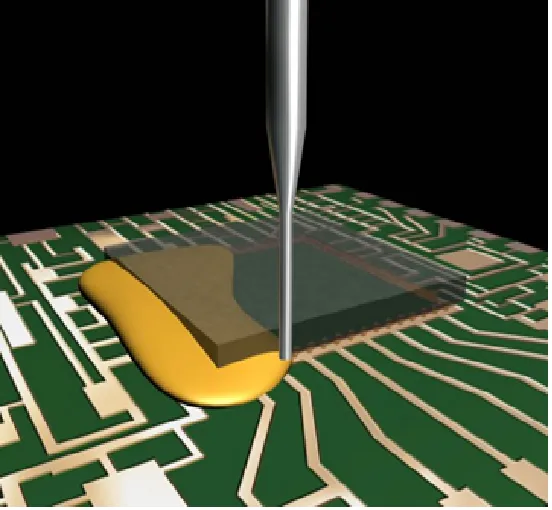
PCB underfill solves this by flooding the gap beneath the component with a low-viscosity epoxy resin, which cures to form a rigid encapsulant that redistributes mechanical and thermal stress across the entire component footprint rather than concentrating it at individual solder balls. The challenge for manufacturers is applying this material at high throughput with micron-level consistency: too little underfill leaves voids that trap moisture; too much creates flash contamination on adjacent pads.
SANCO dispensing machines and coating machines are engineered specifically for this process window. Closed-loop pressure control, heated barrel options and vision-guided needle positioning combine to deliver repeatable bead geometry at speeds compatible with high-volume consumer electronics lines — typically 800–1,200 boards per shift.
Why PCB Underfill Is Difficult to Get Right
Consumer electronics place conflicting demands on the underfill process. Understanding these constraints is the first step to selecting the right dispensing solution.
Extremely Low Stand-off Heights
Modern BGA and CSP components may have stand-off gaps as small as 50–80 µm. Only a low-viscosity underfill material — applied with precise pressure control — can penetrate reliably without voids, especially beneath large packages where flow distances exceed 10 mm.
Strict Void-Free Requirements
IPC-7095 and many OEM specifications mandate void area below 3% as measured by acoustic microscopy (C-SAM). Voids nucleate moisture ingress and fatigue cracks, so dispensing parameters — needle position, flow rate, preheating — must be dialled in precisely and reproduced across every board.
Short Working Life of Material
Underfill epoxies have pot lives ranging from 24 hours to just a few hours once dispensed from the syringe. Dispensing systems must maintain consistent barrel temperature and minimise material exposure to prevent premature gelation that clogs needles and causes rejects mid-run.
No-Clean Flux Contamination
Residual no-clean flux activators on PCB surfaces can reduce adhesion between underfill and substrate. SANCO equipment supports inline plasma activation or UV cleaning steps before dispensing, ensuring surface energy is sufficient for complete wetting.
Component Proximity & Clearance
Consumer electronics boards are densely populated. The dispensing needle must place the bead accurately along one component edge without contaminating adjacent connectors, test pads or optical components. CCD vision alignment compensates for PCB stretch and panel-to-panel variation in real time.
Cycle Time vs. Quality Trade-off
High-volume smartphone and wearable lines target tact times of 15–25 seconds per board. Multi-valve dispensing heads, pre-programmed toolpaths and fast Z-axis response in SANCO machines allow underfill to be applied within the tact without sacrificing bead accuracy.
Key Capabilities for Underfill Applications
Micro-Volume Precision
Minimum dispense volume from 0.001 ml ensures accurate bead placement for the smallest CSP packages without excess material wicking onto adjacent areas.
Heated Barrel & Needle
Integrated barrel heater maintains underfill at 40–60 °C to stabilise viscosity, extend pot life and ensure consistent flow rate across the full production shift.
CCD Vision Alignment
Automatic optical positioning compensates for PCB distortion and component offset, placing the dispensing bead within ±0.05 mm of the target edge — critical for zero-contamination on dense boards.
High-Speed Axis
X/Y axis speed up to 800 mm/s with rapid Z-clearance lets multi-component boards be processed in a single pass, keeping pace with SMT line takt times.
Closed-Loop Pressure Control
Real-time pressure feedback automatically adjusts for viscosity drift as material ages in the barrel, maintaining constant bead width from the first board to the last.
Multi-Material Compatible
Handles capillary underfill, no-flow underfill, corner-bond adhesives, and UV/thermal-cure epoxies through the same platform — reducing changeover time on mixed product lines.
Offline Programming
Import Gerber files or CAD data to auto-generate dispensing toolpaths, reducing programme creation time from hours to minutes when new PCB designs enter production.
SMT Line Integration
SMEMA-compatible conveyor interfaces allow seamless inline integration between reflow oven, inspection AOI and the SANCO underfill station for fully automated material flow.
The PCB Underfill Process Step by Step
A well-controlled underfill process requires precise sequencing from board preparation through curing. SANCO equipment is calibrated to support every stage.
Board Preparation & Preheat
Preheat PCB to 60–80 °C. Surface energy is verified and any flux residue is removed prior to dispensing.
Vision Alignment
CCD camera captures component fiducials. The dispensing toolpath is automatically offset to match actual component placement within ±0.05 mm.
Underfill Dispensing
Epoxy bead is deposited along one or two component edges. Capillary action wicks material beneath the package uniformly.
Fillet Formation
A reinforcing fillet is applied around the full component perimeter using a controlled second-pass dispensing path.
Cure & Inspection
Thermal cure at 150 °C / 30–60 min, or UV-assisted cure for rapid-cure formulations. Post-cure AOI or C-SAM verifies void-free fill.
Underfill Material Types & SANCO Compatibility
SANCO dispensing machines handle the full spectrum of underfill materials used in consumer electronics production.
| Material Type | Viscosity Range | Cure Method | Typical Application | SANCO Compatibility |
|---|---|---|---|---|
| Capillary Flow Underfill (CUF) | 3,000 – 20,000 mPa·s | Thermal 150 °C | BGA, CSP, standard flip-chip on smartphone / tablet PCB | Recommended |
| No-Flow Underfill (NUF) | 1,000 – 8,000 mPa·s | Reflow-activated | Low-standoff CSP on wearables; applied before component placement | Recommended |
| Wafer-Level Underfill (WLUF) | 200 – 2,000 mPa·s | Thermal or UV | Fan-out WLP packages on compact IoT and audio devices | Recommended |
| Corner Bond / Edge Bond | 10,000 – 80,000 mPa·s | UV + Moisture dual-cure | Selective reinforcement of large BGA corners on gaming handhelds | Recommended |
| Reworkable Underfill | 5,000 – 15,000 mPa·s | Thermal 125 °C | High-value RF and memory modules requiring field serviceability | Recommended |
Frequently Asked Questions
What is the minimum gap height that SANCO dispensing machines can fill with underfill?
SANCO dispensing machines support needle gauges as fine as 30G and barrel temperatures up to 80 °C, enabling reliable capillary flow into stand-off gaps as small as 50 µm — typical of advanced CSP and flip-chip packages used in current-generation smartphones and wearables. Contact our application engineers to validate your specific package geometry.
Can the same machine dispense both capillary underfill and corner-bond adhesive?
Yes. SANCO dispensing machines use a quick-change valve head system that allows operators to switch between low-viscosity capillary underfill valves and high-viscosity jetting or auger valves within the same production run. This is particularly useful on mixed-product consumer electronics lines where different PCB designs share the same dispensing platform.
How does SANCO equipment handle pot-life sensitivity of underfill materials?
The heated barrel assembly maintains material at a stable working temperature set-point (typically 40–55 °C) to slow viscosity rise. An integrated auto-purge routine can be scheduled to clear the needle at preset intervals, ensuring fresh material is always at the dispense tip. When pot-life is extremely short, SANCO's two-component mixing dispensing option applies resin and hardener at the needle tip, eliminating barrel pot-life constraints entirely.
What programming format does SANCO support for underfill toolpaths?
SANCO machines accept Gerber files, DXF, and CSV coordinate imports through the offline programming software. Common underfill patterns — L-shape, U-shape, dot-and-drag, and multi-pass fillet — are available as pre-built pattern templates that engineers can apply and modify without writing custom code. Programme files are stored on the controller and recalled by barcode scan or MES signal.
Is SANCO equipment suitable for underfill of flexible PCBs (FPC)?
Flexible PCBs require special fixture tooling to maintain planarity during dispensing. SANCO machines are compatible with customer-supplied vacuum fixtures and can accommodate FPC thicknesses from 0.1 mm. Our application team can advise on fixture design best practices for your specific board outline. Explore our full application library for related flexible PCB dispensing use cases.
Where can I learn about other consumer electronics dispensing and coating applications?
Visit our Applications section for detailed guides covering SMT underfill, camera module bonding, speaker sealing, VCM motor assembly and conformal coating — all common processes in consumer electronics manufacturing. For equipment specifications and pricing, see our Product catalogue.